
It might surprise you but homeopathy can help with musculoskeletal ailments from trauma to arthritis and stimulate faster healing. I say ‘surprise’ because there is a certainly fixity about our skeleton. This is in contrast to our respiratory, digestive systems or even nervous systems that are prone to infections or emotional influences. But remember that our bones are quite alive, if it was not so then they would not heal after a fracture. The skeletal remains found in the grave or museum are but remnants of a one living organism.
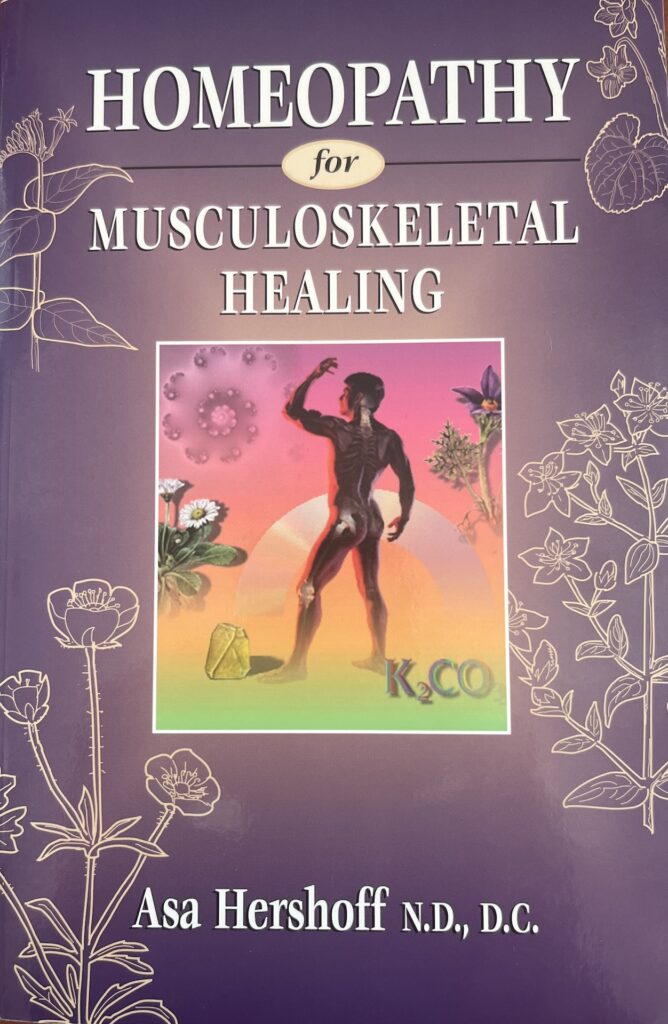
The book pictured is one from my shelf, its American author is a naturopathic doctor (N.D.) and chiropractor (D.C.). The likely first port of call for many musculoskeletal complaints is of course the chiropractor, physiotherapist or osteopath. But homeopathy can have a supporting role.
I have written before on the the complexity of the human body. That a system of such complexity should run harmoniously for most of our life, is quite remarkable. Suffice to say that the ability of the body to monitor, and adjust to our environment exceeds the ability of any machine. There is intelligence here and it is not in any way ‘artificial’.
From a musculoskeletal perspective, Hershoff lists the following:
Looking back I see that in October of 2025 I penned a blog titled The Beneficial Use of Homeopathy in Treating Injury In that article I describe some of the commonly used homeopathic remedies for use in trauma. Note that these are mostly of plant origin. This is typical when addressing self limiting (acute) conditions. Remedies of mineral origin find greater affinity with chronic conditions (e.g. established arthritis).
Homeopathic remedies can usefully complement the various form of physical therapy. It is not by chance the the book pictured above is from the pen of a chiropractor.
However, the overarching and common goal is to stimulate a healing response.
Plantar fasciitis is described here. It is an inflamation of a ligament like band of connective tissue running across the bottom of the foot. It can be quite a stubborn condition and in writing this I came across a clinic in Eastleigh that summarises the options.
Homeopathy is not part of their brief, but I was once told by a medical doctor / homeopath that the remedy Ledum was almost specific for this problem.
Ledum is another plant remedy (sometime known by the name marsh marigold). At the first aid level it is a remedy to be consider in puncture wounds – bites of an insect or animal for example. Should you get a black eye it is a good alternative to Arnica. However, it also has its place musculoskeletal conditions such as inflammation of the achilles tending, synovitis or bursitis (housemaid’s knee) and such like.
I can certainly think of a couple of cases where Plantar Fasciitis did respond to this remedy, but alas I have not found it quite as ‘specific’ as the doctor suggested.
As might be expected, the modalities of Ledum are worse for motion and standing. Rest and ice cold baths or compresses bring relief.
In so far as differentiating between tendonitis and plantar fasciitis is not so easy, especially if the pain is focussed on the heel. Ruta (Golden Rue) has particular affinity for tendon issues. Whist this remedy is also worse for motion and standing, there is an easing of symptoms with gentle movement. Ruta unlike Ledum is better for warm applications.
There are more remedies besides, but the above would be the first to consider. You could take in the 30th centessimal potency morning and evening for a week. If there is no improvement by then try another remedy.
***
This is a curious condition where one or more fingers bend inwards towards the palm of the hand. It may be of minor inconvenience but tends to get worse over time. Surgery may eventually be necessary.
In homeopathy there are a number of potential remedies. A few are briefly summarised below.
A mineral remedy in the potassium family. This is the first homeopathic remedy to think of where there is contraction of flexor tendons. It is in fact one of the homeopathic remedies associated with paralysis in a wider sense. Causticum has a fairly strong physchological picture as the person affected may have an idealistic nature and a strong sense of injustice. Dry cold winds aggravate.
A plant remedy that is considered where the is scar tissue, perhaps as a result of injury or surgical work. It also has affinity with ‘frozen shoulder’ or adhesions (stretch pain) on any joint. That may not be the case with Dupuytren’s contrature, but its role in this conditon remains. This remedy is usually given in low potency for an extended period.
The origin of this remedy is Lignum Vitae, the most dense and hard of woods. There is contractive pain – fingers curved and stiff. This stiffness is also reflected in the mental picture where a rigidness and inflexibility may be apparent. Again used in low potencies over an extended period.
This is quite a significant remedy in homeopathy and associated with nodules and deposits. Arthritic nodosities (ganglions), if present, may be an indicator. There can be an unjustified fear of poverty or financial ruin in the mental picture.
Homeopathic prescribing is always holistic. That is to say, one tries as best possible to reflect the total picture of the patient in the remedy chosen. This will include ‘modalities’ (what makes the condition better or worse), wider physical conditions and if appropriate mental / emotional characteristics. The descriptions above are by necessity brief and a more fulsome analsysis is necessary to match symptoms to remedy.
Should you need advice on recovery from some trauma, be it physical or emotional please get in touch. I offer a free half-hour discovery call which you can book via my website. Or send an email to [email protected]


Disclaimer: I am a qualified professional homeopath and not a medical doctor. The NHS has many resources, and seeking the opinion of your GP is always of value.
Dibden Purlieu, Southampton