
In this blog I wish to consider common misconceptions and truths about Homeopathy.
On common misunderstanding is the homeopathy is some form of herbal medicine. It is true that plants are the starting point for about half of the homeopathic medicines. However, homeopathic remedies are ultramolecular (potentised ultra-dilutions) and made by specialist pharmacies. This process is described in an earlier blog: What is Homeopathic Medicine made of?
But in this blog I wish to focus on the words in the preface to a book I have just finished reading, titled Homeopathic Method authored by Dr Jeremy Swayne.
Dr Swayne is a retired GP of some 38 years experience, and a former Dean of the Faculty of Homeopathy. This medical faculty has is 101st Congress in Warwick next week (19-22 November 2026). He is also ordained as a priest in the Church of England. This last ‘string to his bow’ is important in the context of this article.
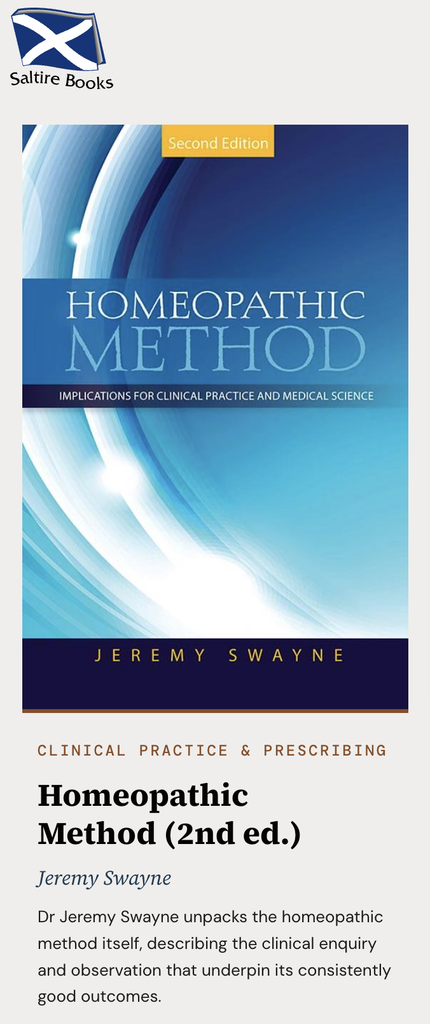
In the preface to the first edition of his book, he opens with the words:
“Homeopathy provokes a wide range of attitudes amongst its opponents and its adherents. Amongst the opponents two extremes are represented by the view, on the one hand, that it is blasphemy against the god of contemporary science, and on the other amongst some fundamentalist Christians, that it is the work of the devil.”
As a retired chartered engineer a scientific pursuit, and a church attender, I have come across both these viewpoints. I find this fascinating.
To the scientist of a certain persuasion, the ultramolecular nature of homeopathic medicines (meaning too dilute) means that they can have no medicinal value. To the Christian fundamentalist, it is seen as occult, or witchcraft – at any rate contrary to the will of God.
Either way the logic is somewhat lost on me.
I perceive two dogmatic positions. Science and Religion each holding the view that they represent the ‘alpha’ and ‘omega’ of all things. Curiously, neither have much time for the other, though they actually have much in common, representing a polarity of argument.
I wrote a blog on this subject back in 2024 and reprise below an interesting perspective from a notable scientist and paleontologist, the late Stephen Jay Gould. He expressed the division between religion and science as ‘Non overlapping magesteria‘, sometimes termed NOMA. Drawing from a summary in Wikipedia I find this succinct quotation from Gould in 1997:
Religion is too important to too many people for any dismissal or denigration of the comfort still sought by many folks from theology. I may, for example, privately suspect that papal insistence on divine infusion of the soul represents a sop to our fears, a device for maintaining a belief in human superiority within an evolutionary world offering no privileged position to any creature. But I also know that souls represent a subject outside the magisterium of science.
My world cannot prove or disprove such a notion, and the concept of souls cannot threaten or impact my domain. Moreover, while I cannot personally accept the Catholic view of souls, I surely honor the metaphorical value of such a concept both for grounding moral discussion and for expressing what we most value about human potentiality: our decency, care, and all the ethical and intellectual struggles that the evolution of consciousness imposed upon us.’
Respectful as I am of Gould’s analysis of this dilemma, it seems strange to me that religion and science do not overlap or more accurately form some sort of continuum. That such a continuum exists between worlds material and immaterial warrants scientific exploration is central to the work of the Scientific and Medical Network to which I suscribe.
Homeopathic philopsophy assuredly recognises this continuum between the immaterial (spiritual) and material (physical). Central to Homeopathy – but not modern science – is a non-material life force, which animates the physical. It is a theme I have written on before. Homeopathy in my view is perfectly compatible with Christianity (and other religions).
The simple answer is that it is not known. But two hundred years of homeopathic pratice and countless thousands of patients infer that it does. Its core principle is the law of similars, that is to say ‘like cures like’.
Put more prosaically by Dr Swayne:
“Homeopathic medicines act therapeutically in patients whose clinical picture is closely similar to the pathogenic effects of the source material of the medicine.“
But as stated, for some the ultramolecular basis of the medicines means that they cannot act therapeutically. So homeopathy is solely placebo. Dr Swayne and many researchers do not deny the power of placebo, and indeed argue that placebo has long been part of the medical art and needs to be better understood.
None doubt there is merit in the thorough homeopathic consultation, something in short supply given the financial and time pressures on the NHS. But then the imperative of prescribing the right remedy is clear, and a big challenge for all homeopaths. If you give the wrong remedy nothing happens. This suggest that there is more than the placebo effect of empathy and time at play.
Dr Samuel Hahnemann who set down the principles of homeopathic practice 200 years ago initially gave material doses of medicine, so the core principle the of law of similars holds good. The process of potentisation that led to ultramolecular medicines came about gradually, and through his experimenting to find the minimum dose necessary to cure the patient. He was a good chemist, but could know nothing of any limit to dilution at the time (this arose from the work of a near contemporary, the italian physicist Avogadro).
One of my favourite words from orthodox medical practice is ‘idiopathic’. It means of unknown cause. There are many things in medicine, desite the advances through (mostly) the twentieth century, that remain mysterious. Many orthodox medicine are repurposed for use in other diseases than first intended because an effect – often unexplained – is noted.
Science author Philip Ball, in his book ‘How Life Works’ acknowledges that biology still cannot explain the mystery of life. Even the mapping the human genome has not solved the conundrum.
Dr Swayne suggests a number of possible avenues of research. The Homeopathy Research Institute was established little over a decade ago. Its prime purpose is to pull together the global efforts of researchers world wide. But reseach needs money and in comparison to the big pharmaceutical corporations the HRI budget is tiny.
My personal view in this information age is that a homeopathic medicine informs; a bit like a software download. This acts as a stimulus for healing. None argue that its effect is biochemical in the manner of othodox drugs.
Homeopathy maximises the innate healing capacity we all have. That healing capacity is considerable, but not without limits. If you have the misfortune to lose a limb, that cannot be undone either by orthodox or homeopathic means. On the other hand it can help overcome the mental trauma and heal physical scars post surgery say.
Homeopathy can and does strengthen immunity. Reducing susceptibility is a key role. Be that to infection or allergy or inherited weakness (susceptibility often runs across generations).
With an open mind and a recognition that healing takes time.
Where health has been compromised over many years recovery will not be instantaneous. For that reason I offer appointments in blocks of three, discounted by way of encouragement! Not only is the healing process gradual (a function of your vitality and capacity to heal), but it necessitates the practitioner knowing the patient. That is difficult on a single consultation. The word ‘patient’ means what it says!
Orthodox drugs in contrast act directly, biochemically, just as nicotine or alcohol, whose reaction is quick as we all know ;-).
With good forytune the innate healing process will be acting in the background, but this is not stimulated by the medicine. A simple example is the use of paracetamol containing medicines for the common cold. They may offer symptomatic relief, but they are not curative. It is the background innate process which ultimately heals.
***
The goal of homeopathic treatment is find and correct the root cause of illness where possible.
Perhaps you would be interested in exploring Homeopathy for your health?
I offer a free 30 minute discovery call to allow you to investigate further. Click on the link in the last sentence or the Book Now button on this website (or email me at [email protected])
***


Disclaimer: I am a qualified professional homeopath and not a medical doctor. The NHS has many resources, and seeking the opinion of your GP is always of value.
Dibden Purlieu, Southampton