
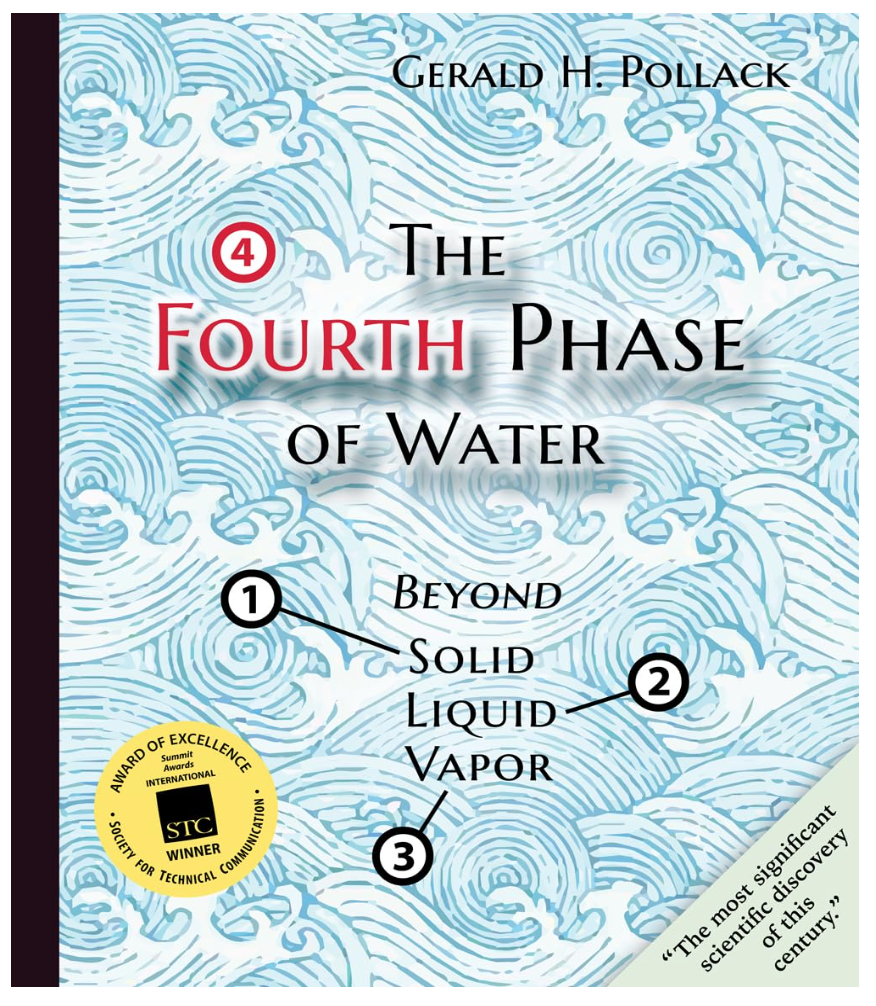
The Fourth Phase of Water is the title of an important book written by Dr Gerald Pollack Professor of bioengineering at Washington University in Seattle. Having just completed a short review of this book for the Journal of the Society of Homeopaths, it seems a suitable topic for this months first blog.
Back in 2018 I attended a conference at the Royal Society of Medicine in London under the banner New Horizons in Water Science – Evidence for Homeopathy at which Jerry Pollack spoke. Being near namesakes, I took particular interest in what he had to say and could not resist introducing myself! He was most congenial which comes across in his writing.
As I write I find that the presentations from the various notables are still to be found on YouTube. Sadly, several are no longer alive, including (Lord) Kenneth Ward-Atherton and Prof. Luc Montagnier. Saddest of all was the loss of Dr Peter Fisher, homeopath and physician to Queen Elizabeth who was killed shortly after the event in a cycling accident in London.
Although almost thirteen years since first published, Prof. Pollack’s book remains a seminal work on the science of water. Nicely illustrated throughout by his son Ethan, this book is very readable and intentionally aimed at the non-specialist reader. As the author says, “if you understand that positive attracts negative and have heard of the periodic table, then you should be able to get the message”.
You may think that for a substance as ubiquitous as water, all that can be known would now be known. This could not be further from the truth. Water behaves in very strange ways, and its peculiarities are considered in the chapters of this book. Moreover, there would be no life without water and as mentioned in an earler article we are mostly water!
Well, not that easy. Pollack tells us of past discoveries in water chemistry that ended badly (you could say in tears). Angels may fear to tread – see the section ‘Homeopathy’ below.
The key theme in this book is EZ water – shorthand for ‘exclusion zone’. In Anerican pronounciation EZ is conveniently E-zee (‘Easy’) water. It is so named due to the ability of this zone to exclude practically everything.
This zone is present where there is an interface with any hydrophilic (water attracting) surface. Most surfaces are hydrophilic from ships hulls to blood vessels. On the other hand materials such as Teflon© (as in non-stick) are hydrophobic (water repelling).
A water molecule (H2O net charge = 0) has no charge, but in the EZ charge separation results. The interfacial zone becomes negative (H3O2 net charge = -1) and is balanced by a corresponding positive zone (H3O net charge = +1) in the bulk water.
The atomic structure in the EZ is stacked honeycomb like, and similar – but not identical – to that of ice. It is not solid like ice nor vapor. It is liquid but not H2O; it is a distinct “Fourth Phase”.
This charge separation of electrons (-ve) and protons (+ve) creates a pseudo battery. And batteries are energy storage devices. External energy sources, most notably infra red energy from sunlight, can maintain this state providing energy for useful work.
One – among many – curiosities of water is that is has a high specific heat compared to most liquids. The specific heat is the amount of energy required to raise the temperature by one degree centigrade. This anomaly may be explained by the fact that some of that energy is used instead to charge the pseudo battery.
And it is. You and I are two-thirds water for a starter.
What is more it holds many mysteries. Here are a few mentioned in the first chapter of The Fourth Phase of Water:
The EZ is key to explaining the above as the later chapters in his book explain.
Few scientists study water, which as the good professor writes, you may find hard to believe. Scientists also. One wrong assumption is that everything about such a common substance must be known. A second is its mystical and sacred qualities, from “holy water” to throwing coins in a fountain.
Pollack summarises one incident in the last category well, and this concerned the work of a respected French immunologist, Jacques Benveniste on the biological activity of ultra high dilutions, whose work suggested that water had the ability to store information – to “remember”.
Benveniste and his team experimented with ultra high dilutions similar to those found in homeopathic medicines. Beneveniste, as Dr Pollack notes was “less interested in homeopathy than in science”. His team surprisingly found that the ultra high dilutions continued to have biological impact.
The then editor of the scientific journal Nature thought this impossible, despite replication of the experiment findings by three other laboratories. Beneveniste’s paper was published in Nature but with the caveat that Nature was allowed to investigate the scientists work. The appointed “committee of peers”, so called, comprised the then editor, Sir John Maddox, a specialist in scientific fraud, Walter Stewart and a “world class” stage magician James Randi. The initial experiments went well, but when repeated by the visitors it failed. Humiliation followed. It was, as Pollack notes, “not a happy time for French science”.
I cannot tell you whether Beneveniste’s experiments were flawed or not. On the other hand, given Benveniste’s credentials, he surely warranted greater respect. Perhaps he was in error, but there was never any evidence of fraud. He died in 2004. Others have replicated his results since, but as I said, angels fear to tread…
The Fourth Phase of Water stands in tribute to the University of Washington team who had the courage to take a step back and forge a new path to better understand the social (bulk) behaviour of water.
At the London conference Prof. Pollack did hypothesise that the EZ molecular structure was not dissimilar to that of silica and consequently may indeed have information storage potential in the manner of a memory stick. This is not in the book, but the EZ may play a part in many phenomena. Possible candidates are ranked under “out of a limb meter” – some further out than others.
What makes this book truly important is Prof. Pollack’s assessment of current scientific endeavour.
He laments the shift away from a focus on “foundational mechanisms” during his forty year career; “a quest for detail seems to have supplanted the quest for simple unifying truths”, he says. Drawing analogy with the tree of knowledge, science today “focuses on the twigs assuming the supporting limbs are robust”. For this reason “scientific truth” is to be found in the study of the water molecule and not bulk water phenomena.
This standpoint seems to me to be analogous to the thrust of current ever-reductionist medical research in contrast to the holism of homeopathy. It was not always thus, and Pollack gives dues credit to the observations by Russian scientists during the Cold War era and others since (West and East) who postulated the same novel properties now re-discovered and summarised in this book.
***
Needless to say, my personal experience of homeopathy is positive, were it not so I would do something else! So, should you care to explore the power of homeopathy please book a free 30 minute Discovery Call via this button.
And if you are in an organisation that would be interested a short talk (usually free) – tailored to your needs – please email me.
This blog is about remembering the past and specifically the benefits of homeopathy.
The thing is we do forget. The eleventh hour of the eleventh day of the eleventh month is soon upon us and it serves indeed as a reminder of past conflicts.
But I suspect for most youngsters the two world wars might as well be the Battle of Hastings or Waterloo, though surviving film footage does resonate across time. My late father served in the western desert and Italy in WW2. Were he alive he would be now 106!

Of course it is not just about conflicts distant in time. I read this weekend the report of a recent train derailment (2001) in Scotland, fortunately without casualties. The investigators found that it had much in common with the 1988 Clapham rail disaster (wiring error) which cost the lives of 35 people.
The late Trevor Kletz, whom I once met in my Chemical Engineering days, wrote many books on the theme of “What went wrong” – to quote one title. It had a sequel, “Still going wrong”, reminding readers of the shortnes of corporate memory.
I recall him quoting a boy on the radio who notably said that “he didn’t have a memory only a ‘forgett-ory'”. Quite.
Alas, we forget the past and consequences follow.

Not all amnesia is entirely accidental. All too often the past is denied; inconvenient truths and wisdom brushed aside. The reasons are mixed, there may be gain (corporate or personal), or maybe just a biased manner of thinking.
Just over a century ago John D Rockefeller and Andrew Carnegie were the equivalent of today’s Bill Gates, Mark Zuckerberg and more. Through their wealth they funded various charitable foundations that had great influence.
I don’t wish to say that they were bad people. Carnegie, whose humble beginnings were in Dunfermline, Scotland funded many public libraries throughout that land and beyond (the link opens with a picture of my local library in Rutherglen, where I was born).
However, what the poweful have is influence to move society in the direction they believe is best. In this towards what we know as western scientific medicine or allopathy (not that homeopathy is unscientific – anything but).
The gentleman was an a academic engaged by the aformentioned to look into medical training in the USA.
Here is a nice summary of his contribution.
Medicine is generally recognised as a balance between art and science. Science today is solely focused on the material world, a subject I have touched on before. However, human beings are more than a bundle of molecules.
There is a growing concern today that the application of science is too narrow and you may care to read the Galileo Report of the Scientific and Medical Network.
The picture below is of a monument located in the centre of Washington D.C. The first monument in that city to a non-US citizen (he was German). Who was this man to get such a grand monument?
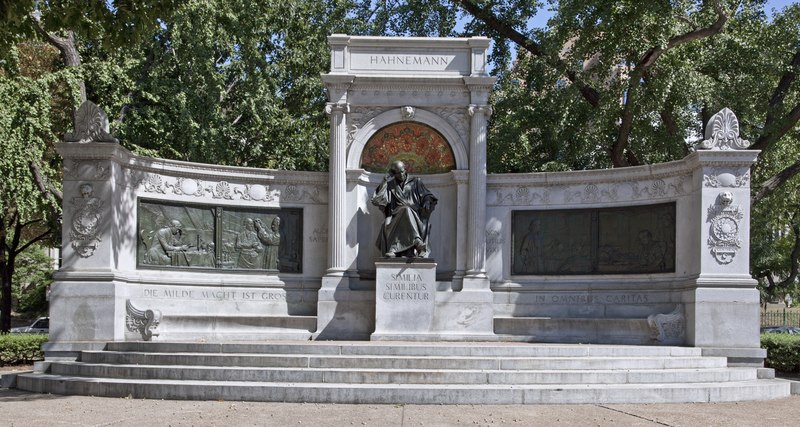
Hahnemann (1755-1843) is considered the founding father of homeopathy. A scientist before the term was in general use and polymath (he knew many languages). His medical work was of huge significance. Here is a short summary from the Journal of the Royal Society of Medicine. Yet you wont find mention of him in western medical schools today.
Homeopathy was a major force in America at the start of the twentieth century. It’s demise stems from the influence of Abraham Flexner and his sponsors.
Medicine was set a path to that which we see today. There have been many benefits, but all in the garden is not rosy as the burden of prescription costs to the NHS might attest.
I suggest – well obviously I would! – that we need to look again not just at homeopathy, but naturopathic, and medicine in all its forms practiced throughout the world.
Medical science today is too narrow in its application and the ‘art’ has all but disappeared (though many physicians still recognise the art in what they do).
Hahnemann’s seminal work is the Organon of Medicine, which is still in print. The opening aphorisms shown below speak to us through time. The rest is not bad either – actually, very profound.
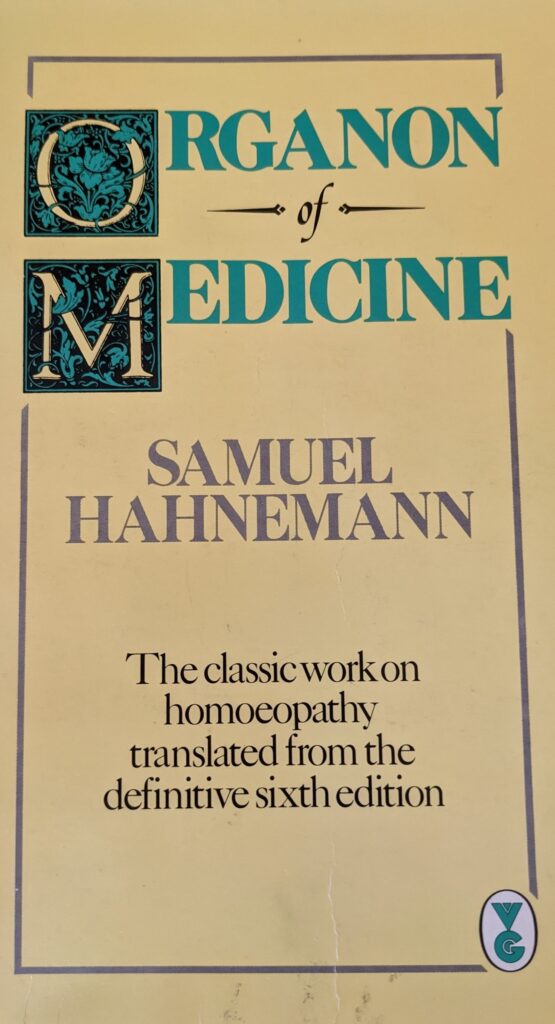
Aphorism 1: The physician’s highest calling, his only calling, is to make sick people healthy – to heal as it is termed.
Aphorism 2: The highest ideal of therapy is to restore health rapidly, gently, permanently; to remove and destroy the whole disease in the shortest, surest, least harmful way, according to clearly comprehensible principles.
Dr Samuel Hahnemann, Organon of Medicine
Isn’t this a fantastic looking flower? It is an ornamental hybrid of the common onion from which the homeopathic remedy Allium Cepa derives.
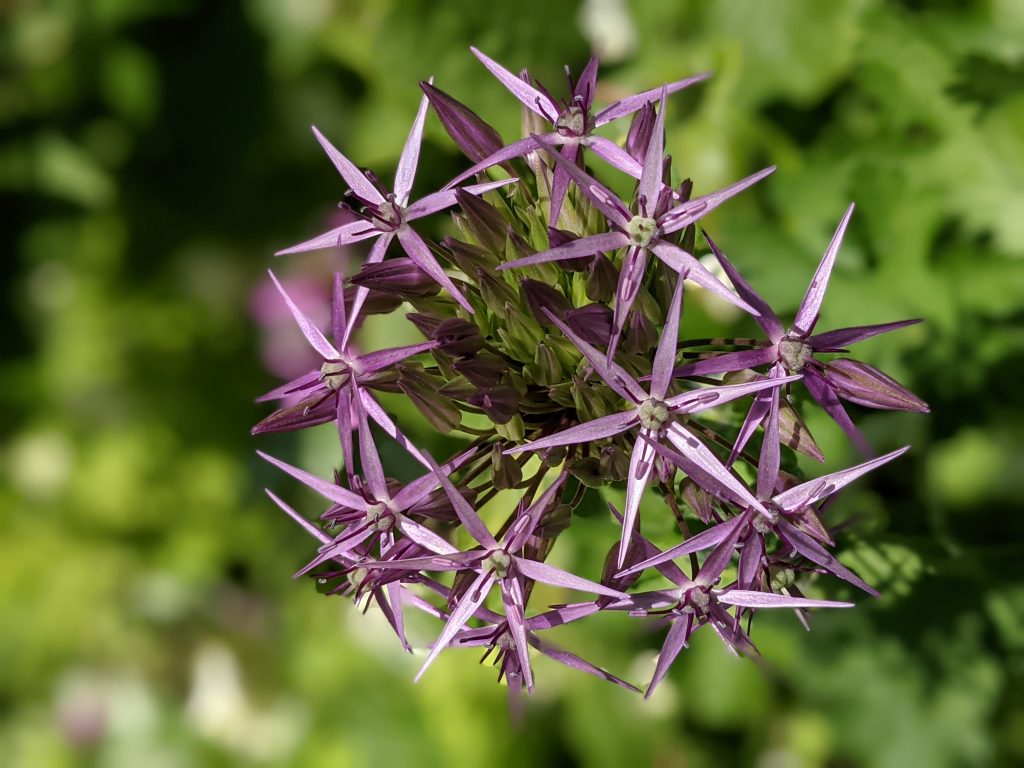
The name which may derive from two Celtic words “all” and “cep”, meaning “hot” and “head”. In full bloom the flower is indeed like a head – a big beautiful sphere.
The onion family includes garlic and leeks. Plants used nutritionally and medicinally for centuries. Today the medicinal benefits are still recognised – here is one article – read more
In folklore, even in the 19th century, placing sliced onions around the home, or in a bag worn around the neck was considered to protect against contagion during epidemics.
Perhaps we should revisit past wisdom, given the current (Covid) challenges? But I suspect sending your children back to school with a bag of chopped onions around their neck might not be popular?
When chopping onions for the cooking pot streaming eyes and runny nose is all too familiar! This is “coryza” or “rhinitis” in medical parlance.
As a homeopathic medicine, one paarticular use of Allium Cepa is in the treatment of an attack of “hay fever”, whose symptoms of coryza, as you all know, are rather similar to those from chopping onions. The nasal discharge is acrid and that from the eye bland.
The homeopathic core principle is “like cures like”. This means giving a medicine that mimics the symptoms suffered.
Homeopathy supports the body’s attempt to cure. It helps it over “the hill” that needs to be climbed.
As I wrote last month “Jaw Jaw is better than War War”
The body speaks its language – it informs; we must listen and act accordingly.
The runny nose of the common cold can be similar to the characteristics of Allium Cepa, but in this case it may be best to suffer the inconvenience as the discharge from the nose has a purpose – namely to eliminate the virus.
Sometimes it is best not to supress symptoms. That includes the use of over the counter remedies such as LemSip and so on. Yes, you feel better but you are hampering the healing.
Symptoms, from a homeopathic perspective, are not just an inconvenience – they point the way to cure.
They inform.
Cutting edge Quantum Physics tells us that our entire universe is “informed”. Indeed, it tells us that we are “informed” – right from the moment of our birth to our last breath.
Current thinking is that the brain is a sort of transmitter / receiver, as much as a pseudo computer for processing our thoughts and bodily signals.
So, the brain may be receiving “downloads” – something like the downloads to our electronic gadgets. Fascinating.
Last night, courtesy of the Scientific and Medical Network I listened to Dr Doug Matzke talk about his research into quantum computing.
He has a new book titled “Deep Reality” – tad over my head mathematically – but the fundamental role of “information” in nature is becoming clear.
Homeopathy is information medicine, born ahead of its time.
I am watching an interesting YouTube clip by Dr Zach Bush https://youtu.be/f6zb5rXgRvs. I say ‘am’ because it is quite long and I am taking it in bite size chunks. Quoting from an online version of the Oxford Dictionary he observes that the definition there in of ‘nature’ is the natural world around us; something rather apart from man. Dr Bush draws our attention to the fact that man is actually fully part of nature not ‘apart’ from it. We have long tried to control the natural world, but current crises from pandemic to environmental, suggest a need to better understand our limitations. He is all for science, but points out that science is not a fixed body of knowledge. It is an ongoing endeavour.
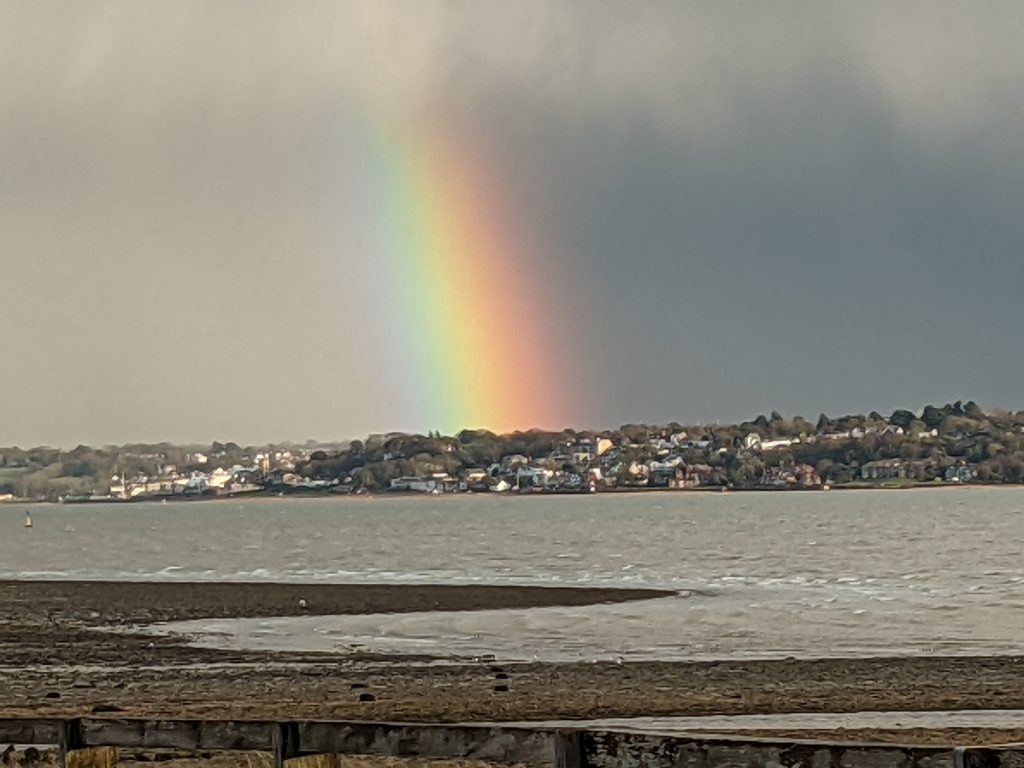
Isle of Wight from Lepe
I took the above photo on a blowy day about a month ago. It is hard to say what early man made of such a scene, and science brings its explanation of light reflected and refracted through water droplets. Nonetheless a rainbow still makes you stop a while and watch. The scientific analysis is good but I bet many at Lepe that felt the colours a omen for better times after a tough year.
A relatively recent scientific endeavour is the micribiome. That is to say, the gut. Dr Bush tells us that our guts are full of viruses and bacteria; many billions of them in fact. The same is true of the soil, the sea and the whole of the natural world. The living world adapts to viruses and bacteria; it has done so from the beginning of time. You might wonder then about our strategies concerning SARS-Cov-2; certainly Dr Bush does.
Complementary medicine has long taken and interest in diet and hence the gut, and on that I will say a little more next time.


Disclaimer: I am a qualified professional homeopath and not a medical doctor. The NHS has many resources, and seeking the opinion of your GP is always of value.
Dibden Purlieu, Southampton