
In this article I consider the key principles of homeopathy, and how they differ from what is understood as conventional or orthodox medicine today.
I touched on this topic in July and return to it from time to time. It is so central to the understanding of homeopathy that I think it a good revision topic to open the New Year.
Given the billions of pounds / dollars spent on conventional medicine, both in terms of research and day to day practise, homeopathy has to be radically different in some way.
There is clearly common ground in such as anatomy and physiology for example.
The difference arises in the understanding of the nature of disease.
And life…
Science writer Philip Ball in his book How Life Works, tells us that despite the remarkable discoveries, 21st century science still cannot explain life.
We learn that humans comprise around 40 trillion cells, and billions of miles of DNA (who worked that out?), carrying far more information that the most advanced computer. Moreover, we are about 70% water by weight; more fluid than solid.
When death comes, we dissolve back into the elements of which we are composed.
My godmother passed away this past week aged ninety-six. Sad, but she had a full life and little sickness beyond recent frailty. We know she is no longer alive, but what does this mean?
The successes of modern medicine arise from the valid perception of our bio-chemical nature. The domain of science is the material world; the concept of an invisible (non-material) harmonising and maintaining life force, does not appeal to current scientific thinking.
For the most part modern medicine perceives us as sophisticated chemical plants. A reasonable stance from the standpoint of a career chemical engineer (ret’d) like myself, but not entirely satisfactory in my opinion!
German physician Dr Samuel Hahnemann (1755-1843), argued that symptoms are but an expression of a disturbed invisible life force. The meticulous Dr Hahnemann, set down the precepts of Homeopathic medicine.
His profound book titled The Organon of Medicine is still in print. It is not a ‘bible’, but the great homeopaths of the last two centuries (mostly medical doctors) find little to fault even to this day.
In fact the great American homeopaths of the early twentieth century dedicated a monument to Hahnemann. It is but a stone’s throw from the White House in Washington D.C. Apparently the first monument to a non-American in that city and the only monument to a physician in the USA.
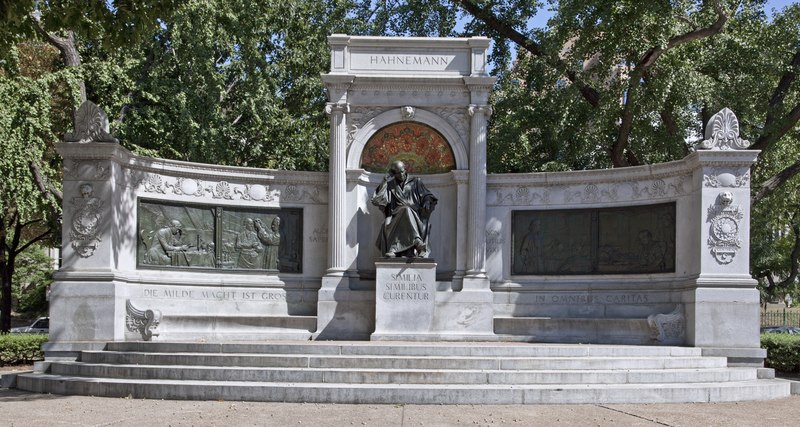
For sure Hahnemann did not have the sophisticated technologies of 20th / 21st century medicine, but it would seem that he had something to say that remains pertinent. Strange then that his work barely gets a mention in medical schools.
Back in the 1990s or thereabouts, British physician and homeopath Dr David Taylor-Reilly once said that if only 5% of all that has been written on Homeopathy was valid it would still be worth taking note. Given the weight of books on my shelves, I can vouch for that.
It is a valid criticism that the mechanism of homeopathic medicines is not understood. Research is needed, but it is a costly business. The pharmaceutical industry fund this by patententing new drugs which generate huge profits. Homeopathic medicines – quite different in nature from modern drugs – have, for the most part been around for years, are not patentable so money is tight.
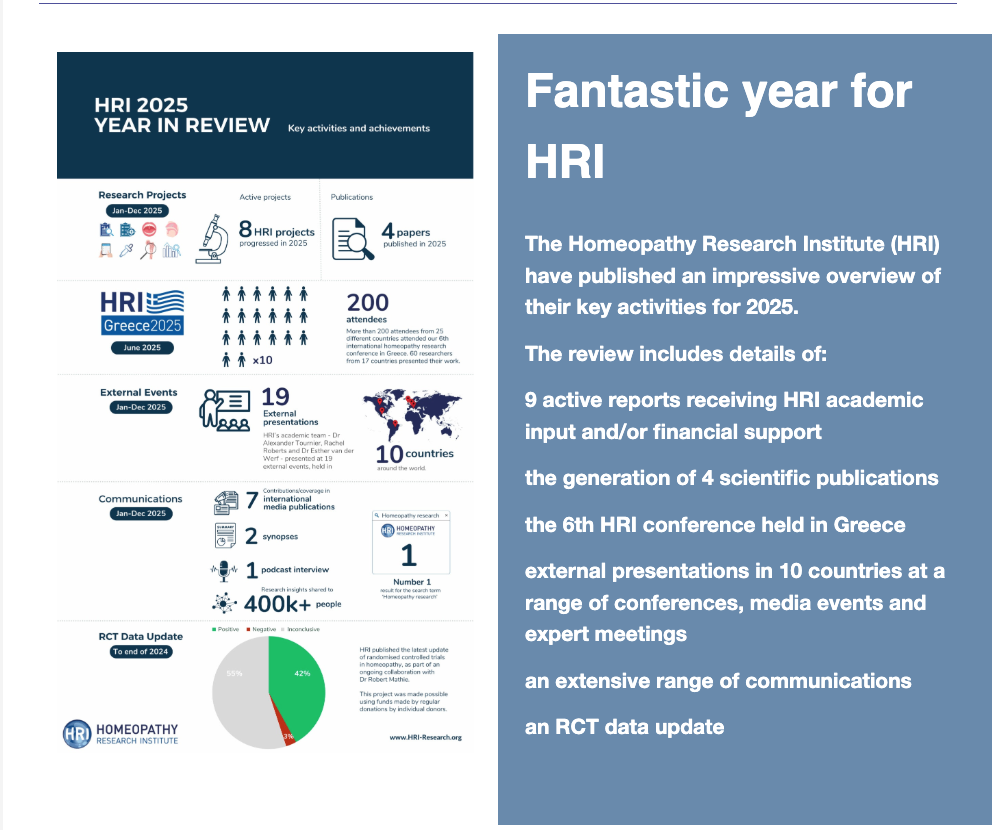
But research is happening. The HRI established a decade or so ago is the main coordinating body and below is a summary for 2025 from their website.
It is a reasonable proposition that life events, acquired or inherited, disrupt the desired natural harmonious state and by extension the life force postulated by Hahnemann.
Harmony needs to be restored. Vitality and health return.
Central tenets of homoepathic medicine are (1) individuality and the (2) totality of symptoms.
Your life experience is unique (individuality). The totality of your symptoms (mental, emotional, physical, historical, inheritance) has meaning beyond inconvenience. It is the total expression of the efforts of the life force to harmonise those trillions of cells.
This leads to another principle, (3) the law of similars. In other words it is better to support these healing efforts rather than suppress then. This contrasts the anti-pathic approach of convential medicine.
This is not to deny the virtue of (say) antibiotics (note ‘anti’), but it is another way of thinking that warrants reflection not dismissal.
The last key principle is (4) less is more when it comes to medicines. Modern medicine treats with more not less (extra strength pain relief say), so this is a controversial subject.
Hahnemann, was physician, liguist and chemist – a polymath of his time. Through experimentation he moved from the material medicines of his day (herbal and mineral) to ever smaller concentrations and got results.
Simply put, he found that the less material the medicine the better it acted on the non-material life force. It is a good place to start. Considering the growing resistance to antibiotics alone, it would be better to reserve their use for heroic medicine where it is needed.
Homeopathy is generally not quick-fix medicine. The timeline for decline and recovery in health are proportional.
The goal is cure and not symptom management. Of course, we are dynamic beings living in space and time, and our health-span is not without limits. Nonetheless, the foundations built though childhood and middle years are reflected in later life.
New Year brings my wishes for your good health and happiness. If disharmony is affecting your health in 2026, consider Hahnemann’s wisdom and homeopathic medicine.

Disclaimer: I am a qualified professional homeopath and not a medical doctor. The NHS has many resources, and seeking the opinion of your GP is always of value.
Dibden Purlieu, Southampton