
In ‘Explaining Homeopathy’ I consider the differences in approach between homeopathy what we today considered orthodox or conventional medicine.
Conventional medicine, sometimes known as Western Scientific or Allopathic Medicine has seen a century and a half of progress. Medicine cast off its shadow of blood letting, and purgatives that did more harm than good. Germ theory, and drug treatments from the humble Aspirin to 20th century antibiotics, and now the latest biologics are lauded today.

You might then think that the homeopathic approach to medicine is ‘old hat’, in comparison.
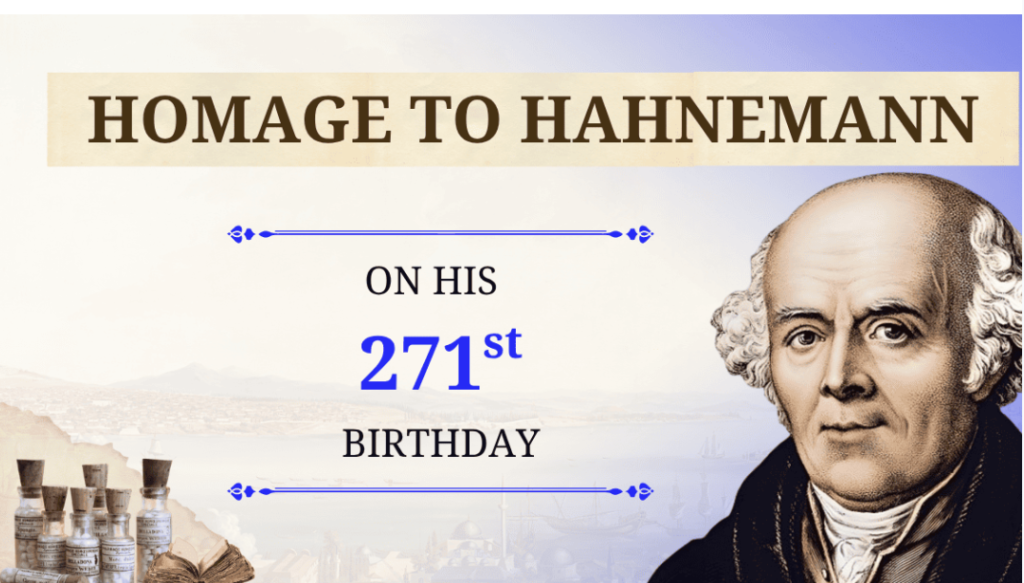
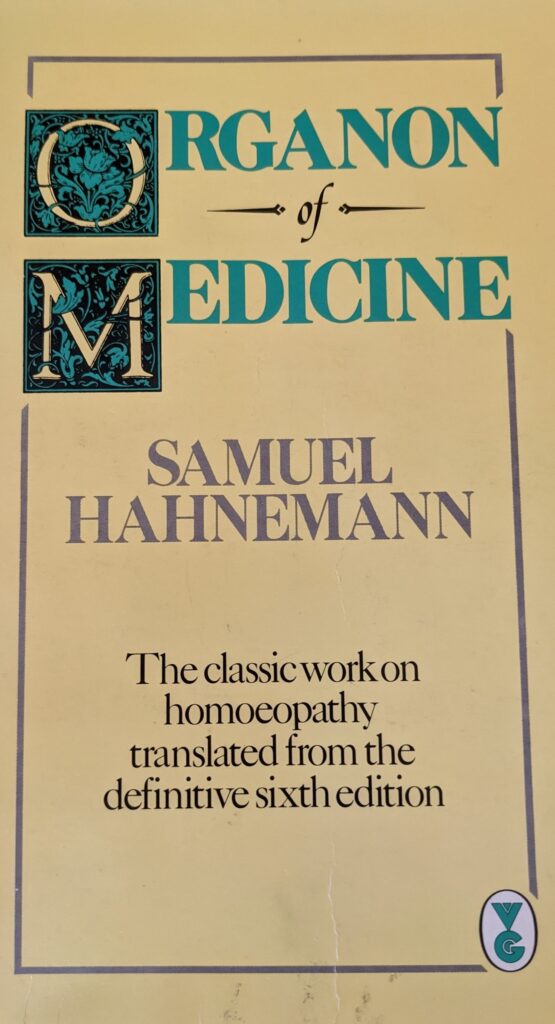
10th April marks the 271st anniversary of the birth of Dr Samuel Hahnemann. He set out the principles of homeopathic treatment in a book titled The Organon of Medicine, still in print. This was also a scientific endeavour. Notably, he perceived the human organism in more subtle ways that the biochemical model of current orthodoxy.
Yet, in the last 25 years, there has been downward pressure on homeopathy from the medical establishment. Primarily, this arises from judging homeopathy solely through the lens of the dominant orthodox model.
Yet, globally talented people continue to advance Hahnemann’s thesis. As a consequence, the database of homeopathic remedies has expanded greatly.
So too the understanding of who we are, our purpose, and relationship with the world around.
In contrast, if we look eastwards – notably to India – we find a better balance between different medical models. Importantly, not just in the street, but also at government level. There is respect, even where there is disagreement.
That homeopathy survives in a climate where investment is so biased towards the western scientific model, spotlights its value. It can be ‘alternative’ or ‘complementary’ or neither (no single system can have all the answers). Moreover, it is about choice.
During my studies a decade back, I gave a talk to a ladies group at my local Church. At question time, I was asked about the role of diagnosis in homeopathy. A good question, which I suspect I failed to answer well.
On reflection, ‘diagnosis’ is a point of differentiation between homeopathy and orthodox medicine.

Now, the value of a ‘diagnosis’ is not to be derided . It sets down the likely disease trajectory. Is it self-limiting, or chronic or even life threatening? It is a central tenet of modern medicine, and the domain of the medical professional. Yet, making a accurate diagnosis is not always easy. Hence, in medical literature there is much about differential diagnosis, that is to say making judgment between this or that.
However, diagnosis is not central to the homeopathic method. Why so?
The answer is that from the homeopathic perspective the pathological process behind any disease is different. And behind each pathology is a different person.
For example, your arthritis could be due to a genetic pre-disposition, some traumatic event (physical or mental) or the nature of your work. Or any combination of these and more. This highlights the importance of the (w)holistic concept.
It is worth saying that very few consult a homeopath without having already had a medical diagnosis.
Jeremy Sherr is a notable current day homeopath. Now based in Tanzania, his focus is patients with HIV / AIDS. He continues to teach homeopathy globally.
He writes this:
“There are four basic laws in Homeopathy. These are: the laws of similars, totality, individuality, and minimum dose. These laws do not function as separate entities, but as complementary forces that together create a whole. Each influences the other in a complementary way. Using less than all four does not constitute true homoeopathy.
“Thus, the remedies one buys in pharmacies which are labelled homeopathic are not really homeopathic. Rather, they are prepared according to a homeopathic pharmaceutical procedure (known as potentisation). Taking them cannot be called homoeopathy. Likewise, homoeopathy is not herbalism (though many remedies are of plant origin).
“Consequently, it is not what you use that makes a medicine homeopathic. It is why you use it that makes it so.”
Sherr, notes that there are two ways to cure: by opposites or similars.
He goes on to make an analogy with the martial arts. “if we examine the martial arts, we find that while some systems go against the oncoming force (Karate), others go in the direction of the flow, using the opponent’s force to overcome him (Tai chi, Aikido). These martial arts are much more profound, gentle, and powerful. Like homoeopathy, they go in the direction of the disease force rather than against it.”
Homeopathic remedies (medicines) are ‘proven’ (tested) on a group of healthy individuals. The patterns of symptoms arising in the healthy (supplemented with toxicological data and clinical experience) will stimulate the healing process in patients suffering similar symptoms.
In short this is the Law of Similars.
The concept of ‘totality’ acknowledges that each of the trillions of cells in your body is connected.
Modern medicine is increasingly divided into specialities (cardiologists, rheumatologists etc.), but to the homeopath it is illogical to divorce, say, a skin symptom from other symptoms elsewhere in the body .
Sherr’s prose is again illuminating:
“To understand what totality of symptoms means, we must first discuss their nature. There are two ways of understanding a symptom. Conventional medicine sees each symptom as the whole disease, a random, isolated and unfortunate event that happened to the patient.
Essentially, it views the symptom as a local accident. The logical extension of this thinking is that the symptom should be destroyed by chemicals, or cut out. This is similar to riding in a car and seeing a little red light go on in the dashboard. The red light is irritating, we don’t know what it means, and we become anxious. Therefore, we respond by cutting the wire! The red light vanishes, and we can breathe a sigh of relief until the engine blows.
“From a homeopathic perspective, the red light is only a signal that something is wrong with the interior of the engine. We cannot see the engine, but the light is a message that there is something wrong with it.
“We need to fix the engine, and that is going to need a more thorough approach, because the engine is a complex mechanism in which each part affects the other. Human beings are much more complex than an engine. They certainly cannot be cured by destroying red lights or symptoms.
“The second way of understanding a symptom is as an intelligent attempt of the organism to defend itself. This is an extension of the well-known principle of Homeostasis, the body’s ability to maintain a constant internal environment by adjusting its physiological processes.
Homeostasis is the function of a complex and intelligent system, which is able to regulate its equilibrium by means of multiple dynamic adjustments.”
Homeopathy recognises individuality. This is not so surprising as we all react differently to different stimuli. One of my teachers (Dr Banerjea) taught that you can split the long list of homeopathic remedies almost down the middle according to the reaction of the patient to temperature. Some wear a pullover in summer and others a T-shirt and shorts in winter! Some remedies are characteristically chilly and some hot.
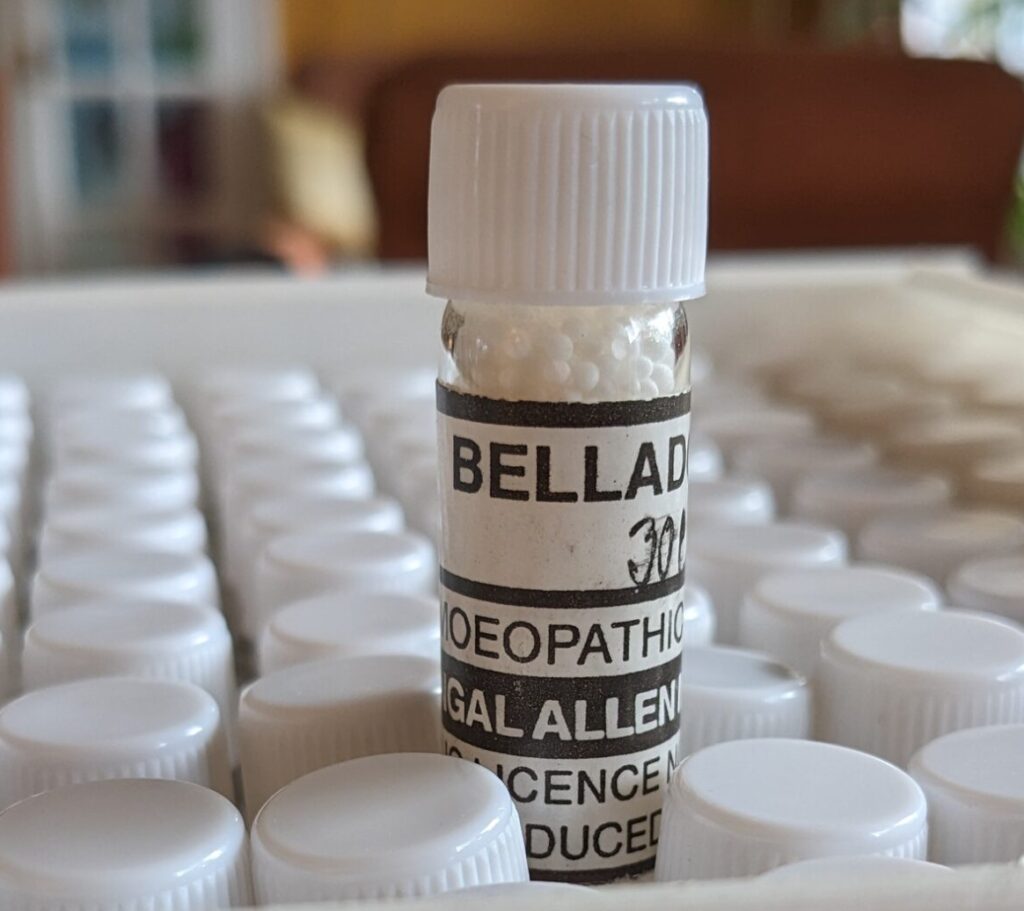
On this topic it is best to read my earlier blog on the nature of homeopathic medicines. Suffice to say, that nearly two centuries of experience by thousands of homeopaths shows that homeopathic remedies work energetically and not biochemically. They are quite distinct from modern pharmaceutical drugs.
I wish to conclude this article reference to a disagreement which led to a parting of ways between the above organisations back in 2021 as it is pertinent to the theme of this article.
For the sake of brevity, I only cover the essence. The Directors of the Society committed many hours to resolving the issues and ‘explaining homeopathy’ was a core issue (in my view).
The PSA is a regulatory oversight body. It sets general standards for those working in healthcare that are not otherwise regulated by law. One largest membership body is those offering counselling therapy. A range of other therapy groups from Reiki to massage are also listed.
The PSA does not profess expertise in any therapy, that is for the individual therapy groups. Its focus is in areas of common interest, such as patient safety etc.
The Society joined this body back in 2014, but chose to end their affiliation in 2021. The unresolved issue was a disagreement over what homeopaths could and could not say on their websites. The PSA was resistant to any indication of homeopaths offering treatment for conditions requiring – to quote just one phrase – ‘medical supervision such as depression, autism, hyperthyroidism and arthritis’.
From what I have written above it should be clear that homeopathic approach disease is different. Homeopaths do not treat according to diagnostic labels, though of course they take cognisance of the diagnosis. As already said, it is rare indeed for a patient to consult a homeopath without having received a diagnosis from their practitioner or specialist.
It is also worth saying that it is unethical to alter medication prescribed by a patients GP or specialist – that is a matter solely between the prescriber and patient.
Homeopaths, be they medically qualified or lay, undertake many years of study and understand their limitations.
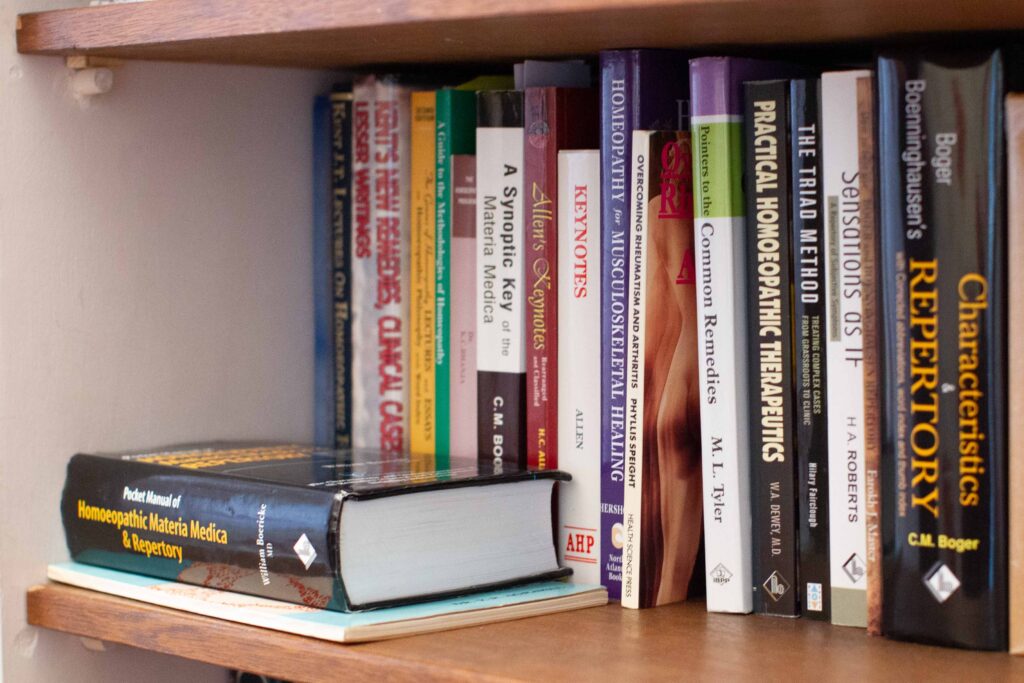
They will direct the patient back to their medical practitioner if required. It may be that homeopathic treatment is inappropriate (which is one reason for the ‘discovery call’).
Nonetheless, homeopathy is a comprehensive system of medicine. Consequently it can treat many conditions including those mentioned above, typically in a complementary manner.
Simply put, homeopathy treats the person not a diagnostic label.
One long experienced Society member, expressing dismay at the PSA position at the time, wrote “Our beautiful, dynamic art / science is too precious to be chained down by external regulation”.
Simply put, the demands of the PSA felt like a straightjacket.
It was not a happy time. Today, the Society of Homeopaths is part of the Integrated Healthcare Collaborative, an body better aligned to the values of the Society.
Now, websites are written in language which those reading can understand. Inevitably, diagnostic labels are used, as that is the language of currency. When prospective patients make that ‘Discovery call’ this is the opportunity to explain homeopathy.
In my experience, they pick up the phone with clear understanding of their situation including diagnostics. But as succinctly put by a colleague, they either seek a solution or the solution given falls short in some regard.
By way of closing example, I worked with patient on long term prescribed thyroid medication. This was neither the main presenting issue nor my focus, but over an extended period of homeopathic treatment, her medication was reduced by her medical practitioner.
It wasn’t something I expected, but reflects a general improvement in health. This is what holistic homeopathy is about.
In general, the homeopath cannot say with certainty what the outcome of treatment will be. It is not quick fix medicine, but neither is it superficial.
It is a voyage of discovery – a return to homeostasis as best possible – which takes time and patience.
***
If care to explore whether homeopathy can help with your health, please book a free 30 minute Discovery Call via this button.
Should you be in an organisation that would be interested a short talk (usually free) – tailored to your needs – please email me


Disclaimer: I am a qualified professional homeopath and not a medical doctor. The NHS has many resources, and seeking the opinion of your GP is always of value.
Dibden Purlieu, Southampton