
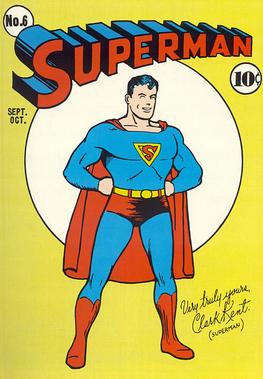
Clark(e) Kent – Supermen (in Homeopathy is clearly, a play on the famous D C Comic hero Superman and his alter ego Clark Kent.
From ‘man’ to ‘men’ and plus an ‘e’ gives a title I could not resist, and an opportunity to introducuce to two homeopathic superheroes.
There have been many notable physicians who chose to put into practice the teachings of the Dr Samuel Hahnemann (1755-1843), who set down the principles of homeopathic practice in the early 19th century.
Clarke’s and Kent’s fame derives from their writing which remains of significance to this day.
Clarke, born in Lincoln, went on to study medicine at the University of Edinburgh achieving his M.D. status in 1877. He went briefly to New Zealand, returning to Liverpool where he planned to set up in practice. There he took the opportunity to learn something of homeopathy from a pharmacy in that city. Subsequently he worked in Ipswich and studied at the London Homeopathic hospital.
By the 1880’s he had relocated to London and was much involved with various homeopathic organisations both at home and abroad.

He was a member of what came to be known as the ‘Cooper Club’. Four notable homeopathic physicians who began meeting over dinner to discuss their cases.
Named after Dublin educated, Robert Thomas Cooper MD (1844-1903), the other founding members were Clarke, Thomas Skinner MD (Edinburgh) (1825-1906), and James Compton Burnett (Glasgow) (1840-1901).
All physicians all of some note, not to mention prodidious workers.
Apparently, Clarke visited his patients in a horse-drawn carraige fitted with a writing desk as he never missed an opportunity to work on his books. No mobile phone distractions then!
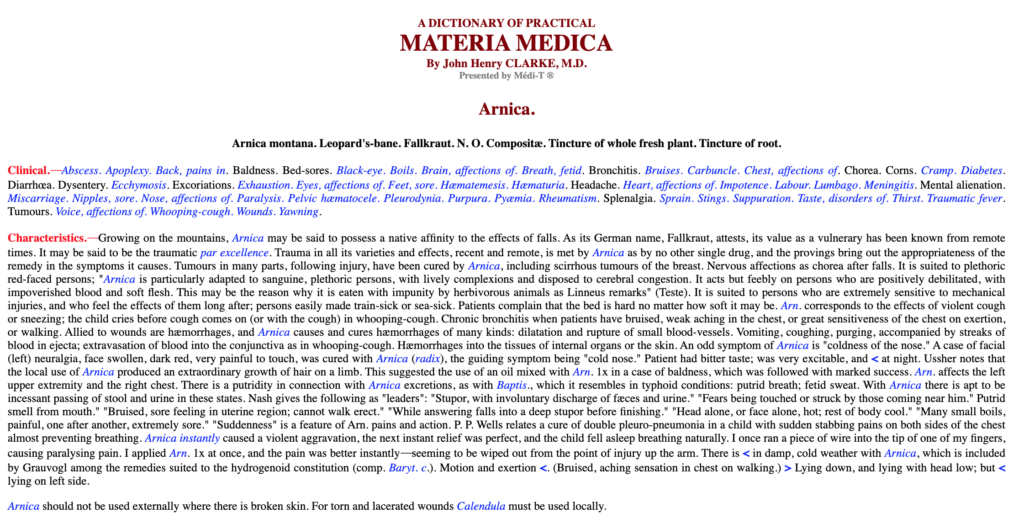
The three volume ‘dictionary’ pictured below is his magnum opus. Produced, he reportedly said, to save himself work! It is still in print and available online. Below is an extract of Clarke’s description for Arnica, by way of example (Arnica is No1 for deep bruising).

Clarke was a man of strong opinions and a powerfull pen. He crossed swords not only with the orthodoxy of the time but also homeopathic establishment. The latter he felt failed to stand up for their profession leading to its eclipse.
The fate of homeopathy has always ebbed and flowed. There was a period of decline after the Great War and Clarke’s willingness to teach the lay practitioner was significant. The establishment of such as The Society of Homeopaths results from this lineage.
His later political booklets were controversial. Some were anti-semitic. But I feel these have to be seen in context. At this distance it is hard to imagine the impact of 800,000 British lives lost. Clarke disliked Germans and argued that Germany and Prussia were Judaic nations whose action risked English Christian culture. He was a man of his time.
Given the subsequent consequences of Naziism this seems a stange view. Yet, if you visit German WW1 cemeteries as I have, you find a significant number Jewish graves, which is counter-intuitive given what was to come during WW2. Though relatively few in number (about 1% of the German population), the Jewish population were influential.
Perhaps that is the point he makes? Actually Britain was quite anti-semitic in the 1930’s. Indeed my late mother told be the Jews were barred from membership at her local tennis club. Hard to imagine.
And so to Superman 2 – if you excuse the pun! Kent’s early history is somewhat enigmatic.
He was born in New York and possibly the result of an incestuous relationship. Be that as it may he was a good student qualifying (Ph.B) in philosophy in 1868 at the young age of 19 in 1868. He gained his medical qualifictions at the Eclectic Medical Institute in Cincinnati in 1871.

His first wife died in 1872 when just 19 years of age. A couple of years later he remarried moving St. Louis Missouri, where he taught anatomy.
When his second wife became ill, and his attempts to help her failed, he summoned the local homeopathic physician who cured her. This led to his conversion to homeopathy around 1878. Various posts followed and in 1890 he founded The Post-Graduate School of Homeopathics in Philadelphia.
Funding for that school came from the founder of Pittsburg Plate Glass, a certain John Pitcairn, who was also a notable member of the Swedenborg Church. Swedenborg was a 18th century Christian Mystic and polymath whose thinking influenced Kent’s understanding of homeopathy. Kent clearly saw parallels with Hahnemann’s expressed view that (1) there is an animating life force which (2) when disturbed causes symptoms (disease).
Be that as it may, his greatest contribution was to compile The Repertory of the Homeopathic Materia Medica a task that took some twenty years.

A repertory is simply a compilation of remedies having correspondence with particular symptoms. Hence, it is an aid to finding the appropriate homepathic remedy. I stress the word aid as the result of repertorisation is one of possibility only. Reference then has to be made to the full remedy picture found in the Materia Medica.
Here is a small example:

Baring minor corrections, Kent’s Repertory was the primary reference work for homeopaths for half a century. The late 20th century saw updates and corrections. As you can see, it is – in modern terminology – a database. Consequently, it lends itself to computerisation and even AI. Type this question into Google AI: “what is a good homeopathic remedy for deep bruises?” and you get this:
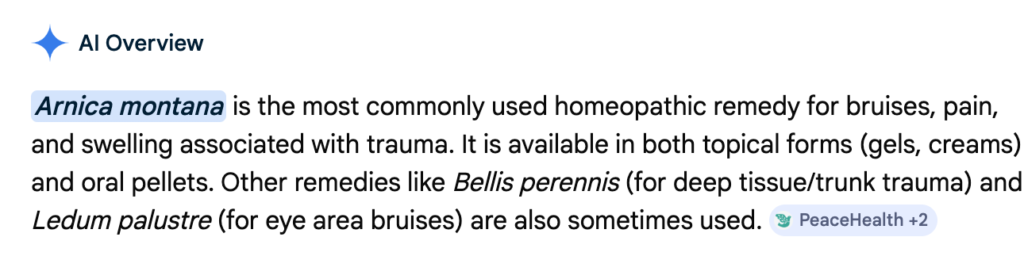
Not bad. Now what would Kent have made of this!
Many notable homeopaths crossed the pond to study with Kent. Amongst them Sir John Weir, Physican to the Royal Household and Douglas Borland whom I mention in my article titled “The Nature of the Child”.
The above are but two notables in the field of homeopathic medicine and more can be gleaned from the anals of Hahnemann House Trust should you be interested.
***
Needless to say I stand but on the shoulders of giants, but should you care to explore the power of homeopathy please book a free 30 minute Discovery Call via this button.
And if you are in an organisation that would be interested a short talk (usually free) – tailored to your needs – please email me.


Disclaimer: I am a qualified professional homeopath and not a medical doctor. The NHS has many resources, and seeking the opinion of your GP is always of value.
Dibden Purlieu, Southampton