
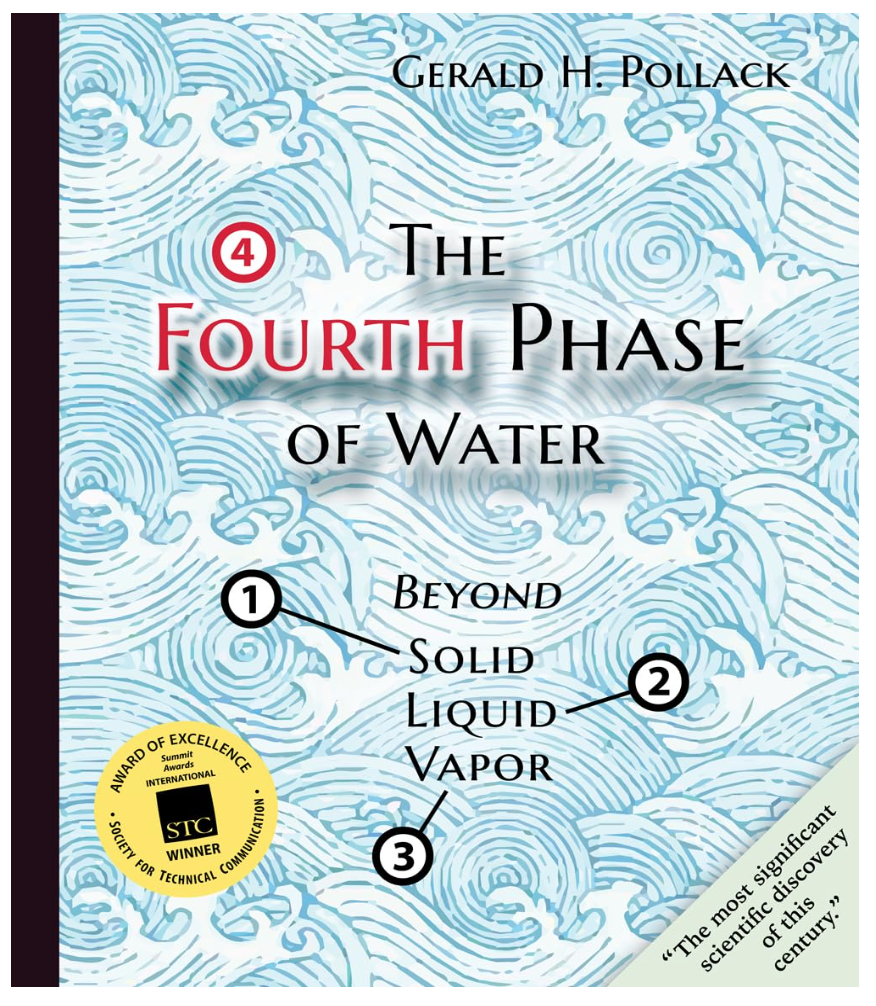
The Fourth Phase of Water is the title of an important book written by Dr Gerald Pollack Professor of bioengineering at Washington University in Seattle. Having just completed a short review of this book for the Journal of the Society of Homeopaths, it seems a suitable topic for this months first blog.
Back in 2018 I attended a conference at the Royal Society of Medicine in London under the banner New Horizons in Water Science – Evidence for Homeopathy at which Jerry Pollack spoke. Being near namesakes, I took particular interest in what he had to say and could not resist introducing myself! He was most congenial which comes across in his writing.
As I write I find that the presentations from the various notables are still to be found on YouTube. Sadly, several are no longer alive, including (Lord) Kenneth Ward-Atherton and Prof. Luc Montagnier. Saddest of all was the loss of Dr Peter Fisher, homeopath and physician to Queen Elizabeth who was killed shortly after the event in a cycling accident in London.
Although almost thirteen years since first published, Prof. Pollack’s book remains a seminal work on the science of water. Nicely illustrated throughout by his son Ethan, this book is very readable and intentionally aimed at the non-specialist reader. As the author says, “if you understand that positive attracts negative and have heard of the periodic table, then you should be able to get the message”.
You may think that for a substance as ubiquitous as water, all that can be known would now be known. This could not be further from the truth. Water behaves in very strange ways, and its peculiarities are considered in the chapters of this book. Moreover, there would be no life without water and as mentioned in an earler article we are mostly water!
Well, not that easy. Pollack tells us of past discoveries in water chemistry that ended badly (you could say in tears). Angels may fear to tread – see the section ‘Homeopathy’ below.
The key theme in this book is EZ water – shorthand for ‘exclusion zone’. In Anerican pronounciation EZ is conveniently E-zee (‘Easy’) water. It is so named due to the ability of this zone to exclude practically everything.
This zone is present where there is an interface with any hydrophilic (water attracting) surface. Most surfaces are hydrophilic from ships hulls to blood vessels. On the other hand materials such as Teflon© (as in non-stick) are hydrophobic (water repelling).
A water molecule (H2O net charge = 0) has no charge, but in the EZ charge separation results. The interfacial zone becomes negative (H3O2 net charge = -1) and is balanced by a corresponding positive zone (H3O net charge = +1) in the bulk water.
The atomic structure in the EZ is stacked honeycomb like, and similar – but not identical – to that of ice. It is not solid like ice nor vapor. It is liquid but not H2O; it is a distinct “Fourth Phase”.
This charge separation of electrons (-ve) and protons (+ve) creates a pseudo battery. And batteries are energy storage devices. External energy sources, most notably infra red energy from sunlight, can maintain this state providing energy for useful work.
One – among many – curiosities of water is that is has a high specific heat compared to most liquids. The specific heat is the amount of energy required to raise the temperature by one degree centigrade. This anomaly may be explained by the fact that some of that energy is used instead to charge the pseudo battery.
And it is. You and I are two-thirds water for a starter.
What is more it holds many mysteries. Here are a few mentioned in the first chapter of The Fourth Phase of Water:
The EZ is key to explaining the above as the later chapters in his book explain.
Few scientists study water, which as the good professor writes, you may find hard to believe. Scientists also. One wrong assumption is that everything about such a common substance must be known. A second is its mystical and sacred qualities, from “holy water” to throwing coins in a fountain.
Pollack summarises one incident in the last category well, and this concerned the work of a respected French immunologist, Jacques Benveniste on the biological activity of ultra high dilutions, whose work suggested that water had the ability to store information – to “remember”.
Benveniste and his team experimented with ultra high dilutions similar to those found in homeopathic medicines. Beneveniste, as Dr Pollack notes was “less interested in homeopathy than in science”. His team surprisingly found that the ultra high dilutions continued to have biological impact.
The then editor of the scientific journal Nature thought this impossible, despite replication of the experiment findings by three other laboratories. Beneveniste’s paper was published in Nature but with the caveat that Nature was allowed to investigate the scientists work. The appointed “committee of peers”, so called, comprised the then editor, Sir John Maddox, a specialist in scientific fraud, Walter Stewart and a “world class” stage magician James Randi. The initial experiments went well, but when repeated by the visitors it failed. Humiliation followed. It was, as Pollack notes, “not a happy time for French science”.
I cannot tell you whether Beneveniste’s experiments were flawed or not. On the other hand, given Benveniste’s credentials, he surely warranted greater respect. Perhaps he was in error, but there was never any evidence of fraud. He died in 2004. Others have replicated his results since, but as I said, angels fear to tread…
The Fourth Phase of Water stands in tribute to the University of Washington team who had the courage to take a step back and forge a new path to better understand the social (bulk) behaviour of water.
At the London conference Prof. Pollack did hypothesise that the EZ molecular structure was not dissimilar to that of silica and consequently may indeed have information storage potential in the manner of a memory stick. This is not in the book, but the EZ may play a part in many phenomena. Possible candidates are ranked under “out of a limb meter” – some further out than others.
What makes this book truly important is Prof. Pollack’s assessment of current scientific endeavour.
He laments the shift away from a focus on “foundational mechanisms” during his forty year career; “a quest for detail seems to have supplanted the quest for simple unifying truths”, he says. Drawing analogy with the tree of knowledge, science today “focuses on the twigs assuming the supporting limbs are robust”. For this reason “scientific truth” is to be found in the study of the water molecule and not bulk water phenomena.
This standpoint seems to me to be analogous to the thrust of current ever-reductionist medical research in contrast to the holism of homeopathy. It was not always thus, and Pollack gives dues credit to the observations by Russian scientists during the Cold War era and others since (West and East) who postulated the same novel properties now re-discovered and summarised in this book.
***
Needless to say, my personal experience of homeopathy is positive, were it not so I would do something else! So, should you care to explore the power of homeopathy please book a free 30 minute Discovery Call via this button.
And if you are in an organisation that would be interested a short talk (usually free) – tailored to your needs – please email me.


Disclaimer: I am a qualified professional homeopath and not a medical doctor. The NHS has many resources, and seeking the opinion of your GP is always of value.
Dibden Purlieu, Southampton